Spinal Fusion Recovery Estimator
Recovery Timeline Calculator
Estimate your spinal fusion recovery timeline based on key factors affecting healing.
Your Estimated Recovery Timeline
Enter your details to see your personalized recovery estimate.
When someone talks about orthopedic surgery, they often think of a broken bone or a torn ligament-something fixable with a cast or a few weeks of rest. But some orthopedic procedures aren’t just about fixing a structure. They’re about rebuilding a body’s ability to move, stand, or even walk again. And among all these surgeries, one stands out as the most grueling to recover from: spinal fusion.
Why Spinal Fusion Is the Toughest Recovery
Spinal fusion isn’t just a single procedure. It’s a process where two or more vertebrae are permanently joined together using bone grafts, metal rods, and screws. The goal? To stop painful motion in a damaged section of the spine. But stopping motion means your body has to heal bone in a place that’s constantly under stress-your spine moves every time you breathe, sit, stand, or turn over in bed.
Recovery takes months, not weeks. Most patients need at least 3 to 6 months before they can return to light activity. Full recovery-where the bones are fully fused and strength is restored-can take up to a year. That’s longer than most joint replacements, even hip or knee surgeries, which often let people walk the next day.
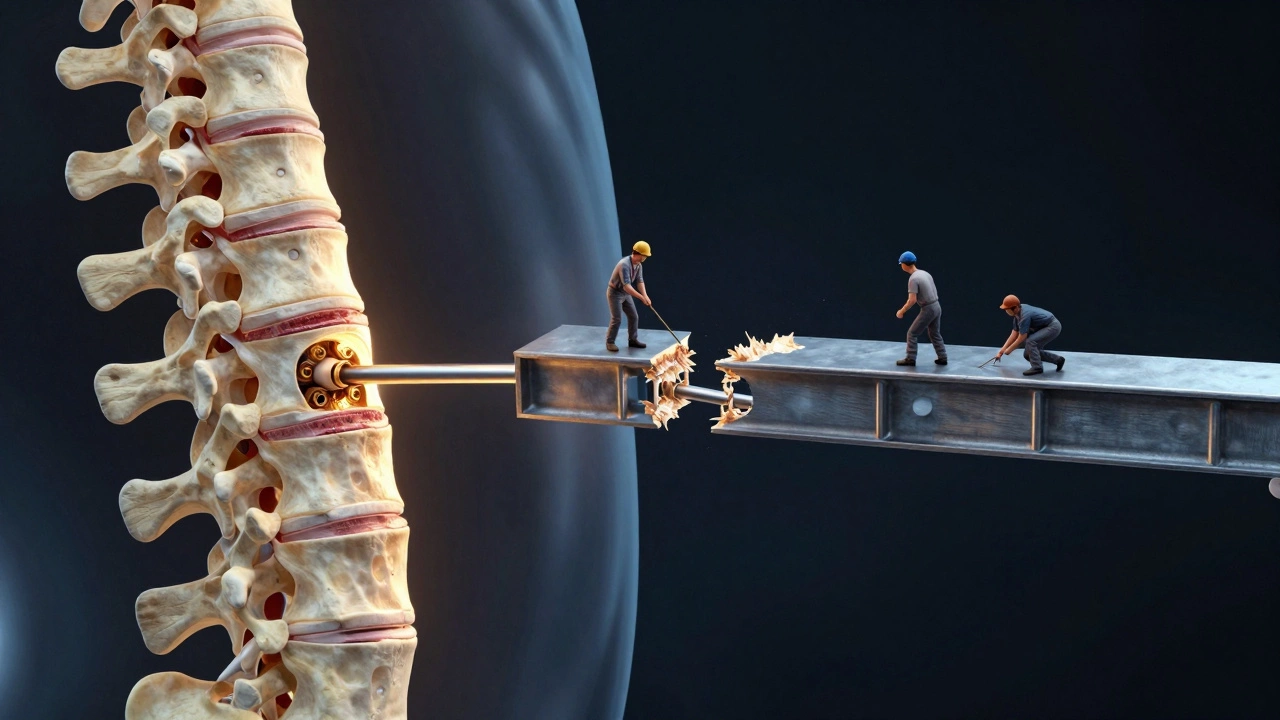
Why? Because bone fusion requires the body to grow new bone tissue across a gap. That’s not like healing a cut. It’s like asking your body to build a bridge between two broken ends of a steel beam, while that beam is still being jostled by every movement you make. Even small motions can delay healing or cause the fusion to fail.
What Makes Recovery So Hard?
There are three big reasons spinal fusion recovery is brutal:
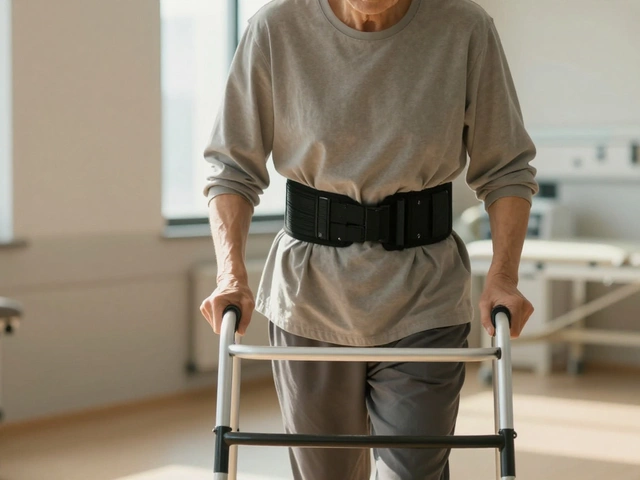
- Immobilization is required-You can’t bend, twist, or lift anything heavy for months. Simple things like tying your shoes or getting out of a car become major tasks. Many patients need help with daily chores for weeks.
- Pain doesn’t go away quickly-Unlike a knee replacement, where pain drops sharply after the first week, spinal fusion pain lingers. Nerve irritation, muscle spasms, and inflammation around the surgical site can last for months. Some patients report chronic discomfort even after full healing.
- Rehabilitation is slow and demanding-Physical therapy starts early, but progress is measured in millimeters, not miles. You relearn how to walk without straining your spine. Core strength must be rebuilt from scratch. Many patients hit plateaus where they feel stuck, and motivation drops.
A 2024 study tracking 1,200 spinal fusion patients found that 42% still had moderate to severe pain at the 6-month mark. Only 18% reported feeling “back to normal” by then. Compare that to total knee replacements, where 78% of patients said they felt significantly better by 3 months.
Other Tough Orthopedic Surgeries (And Why They’re Not #1)
Spinal fusion isn’t the only hard recovery. Other surgeries are also brutal-but for different reasons.
Total Joint Replacements (Hip, Knee, Shoulder)
These surgeries replace worn-out joints with metal and plastic. They’re common, and they work well. Recovery is faster because the goal isn’t bone fusion-it’s motion. Most people walk the same day or next day after surgery. Pain fades quickly. Physical therapy is intense, but progress is visible. You’re not waiting for bones to grow together-you’re just retraining muscles and joints.
Complex Fracture Repairs (Pelvis, Femur, Multiple Bones)
When someone breaks their pelvis or femur in a high-impact accident, surgery is needed to realign and stabilize the bones. Recovery can take 6 to 12 months. But unlike spinal fusion, these bones aren’t under constant movement stress. Once stabilized, they heal like any other fracture-just slower. Patients often regain mobility faster than spinal fusion patients because they don’t have to relearn basic posture and movement patterns.
Revision Joint Surgery
When a hip or knee replacement fails and needs to be redone, the surgery is more complex. Scar tissue, bone loss, and infection risk make it harder. Recovery is longer than a first-time replacement-but still shorter than spinal fusion. The body doesn’t have to grow new bone across a moving joint. It just has to heal around new implants.
What Happens During Recovery?
Recovery from spinal fusion isn’t a straight line. It’s a series of plateaus and setbacks.
- Weeks 1-4: Pain management is key. Most patients are on opioids or strong NSAIDs. Walking is limited to short distances. Sitting is uncomfortable. Sleeping is hard-you need special pillows and positions.
- Weeks 5-12: Physical therapy begins. Focus is on gentle core activation, breathing exercises, and learning to move safely. Many patients feel frustrated because progress feels invisible.
- Months 3-6: Bone fusion starts to show on X-rays. Pain decreases, but stiffness remains. Returning to work (even desk jobs) is possible for some, but lifting, driving long distances, or bending still isn’t safe.
- Months 6-12: This is when most people start to feel like themselves again. Strength returns. Mobility improves. But some never fully regain their pre-surgery flexibility.
One patient from Bangalore, a 52-year-old school teacher, told her physiotherapist: “I thought I’d be back teaching by Christmas. It’s now June, and I still can’t pick up my students’ books without my back screaming.” That’s not rare. It’s normal.
What Helps Recovery? What Hurts It?
Not everyone recovers the same way. Some factors make a huge difference:
- What helps: Quitting smoking (nicotine kills bone growth), eating enough protein and vitamin D, doing prescribed exercises daily, avoiding prolonged sitting, and having strong social support.
- What hurts: Smoking, obesity, diabetes, poor nutrition, skipping physical therapy, and trying to “push through” pain too soon. One study showed smokers had a 30% higher chance of fusion failure.
Even something as simple as your mattress matters. A too-soft bed can twist your spine at night. A too-hard one can cause pressure sores. Most surgeons recommend a medium-firm mattress for spinal fusion patients.
When Do You Know It’s Working?
Recovery isn’t just about pain going away. It’s about function returning.
Signs your fusion is healing:
- You can sit for 30 minutes without needing to stand up
- You can walk 10 minutes without needing to rest
- You can get out of bed without using your arms to push up
- You’re sleeping through the night without pain
- Your doctor sees bone growth on follow-up X-rays
If you’re not seeing any of these by month 4, talk to your surgeon. It might mean the fusion is delayed-or worse, failed.

Is There a Better Way?
Some patients wonder: Why fuse at all? Can’t we just replace the disc like a knee replacement?
Artificial disc replacement (ADR) exists. It’s an alternative to fusion for certain cases-mainly single-level degeneration without instability. ADR preserves motion, so recovery is faster. But it’s not for everyone. If you have severe arthritis, bone spurs, or instability, fusion is still the gold standard. And even ADR isn’t easy-it still requires months of recovery.
For now, spinal fusion remains the most reliable way to fix serious spinal damage. But it’s not a quick fix. It’s a life-altering commitment.
What’s the Real Goal?
The goal isn’t to be pain-free. It’s to be functional. To stand without fear. To walk without a cane. To sleep without painkillers.
Spinal fusion isn’t about getting back to who you were. It’s about becoming someone who can live with a new spine. And that’s a slow, quiet, exhausting kind of victory.
How long does it take to fully recover from spinal fusion surgery?
Full recovery from spinal fusion typically takes 6 to 12 months. While most patients can return to light activities by 3 to 6 months, the bones need a full year to fuse completely. X-rays are used to confirm fusion, and physical strength continues to improve even after pain subsides.
Can you walk after spinal fusion surgery?
Yes, most patients are encouraged to walk the day after surgery, but only short distances. Walking helps circulation and prevents blood clots. However, you’ll need to avoid bending, twisting, or lifting for months. Walking becomes easier over time, but it’s a slow process-many patients walk slowly and cautiously for the first few months.
Is spinal fusion the most painful orthopedic surgery?
It’s not always the most painful immediately after surgery, but it’s the most prolonged. Pain from spinal fusion often lasts for months due to nerve irritation and muscle spasms. Unlike joint replacements, where pain drops sharply after a week, spinal fusion pain fades slowly. Many patients report chronic discomfort even after healing.
What are the risks of spinal fusion surgery?
Risks include infection, nerve damage, blood clots, and fusion failure (pseudarthrosis). Smoking, diabetes, and obesity increase these risks. About 10-20% of patients experience incomplete fusion, which may require a second surgery. Long-term, some patients develop adjacent segment disease-where nearby vertebrae wear out faster due to extra stress.
Can you return to work after spinal fusion?
Yes, but timing depends on your job. Desk workers may return in 6-8 weeks with restrictions. Those with physical jobs-like construction, nursing, or delivery-often need 4 to 6 months or more. Lifting, bending, and twisting are restricted for at least 6 months. Many patients switch to less physically demanding roles long-term.
Are there alternatives to spinal fusion?
Yes, for some patients. Artificial disc replacement (ADR) is an option for single-level degeneration without instability. Other non-surgical options include physical therapy, epidural injections, or spinal decompression. But if there’s significant instability, deformity, or nerve compression, fusion remains the most reliable solution.
Final Thoughts
There’s no easy orthopedic surgery. But spinal fusion is different-it doesn’t just heal a body part. It changes how you live. It asks you to be patient when patience is hardest. To move slowly when you’re desperate to move fast. To trust a process that moves at the speed of bone growth.
If you’re facing this surgery, know this: you’re not alone. Thousands go through it every year. The road is long, but many come out on the other side-stronger, more aware, and finally free from the pain that held them back.