IVF Appearance Resemblance Calculator
How Does IVF Affect Your Child's Appearance?
This calculator shows how your child's appearance relates to genetic contribution. Remember: Your child's appearance comes from their biological parents' genes, not the birth parent unless they provided the egg.
Results
Understanding Resemblance
Why does this matter? Many people worry about whether their child will 'look like them' when using IVF with donor gametes. The key to remember is: physical appearance comes from DNA, not from who carries the baby.
Remember: Family isn't defined by genetics alone. It's formed through daily moments of love, care, and connection. As one IVF parent said: "My child doesn't look like me, but I raised her to be my daughter."
When couples turn to IVF to build their family, one of the quietest but deepest questions they often wonder is: Will our baby look like us? Especially for same-sex female couples or single mothers using donor sperm, the question becomes even more personal: Do IVF babies look like both moms? The answer isn’t just about looks-it’s about biology, choice, and the quiet magic of how families are made.
How IVF Works: A Quick Reset
IVF, or in vitro fertilization, is when an egg is fertilized by sperm outside the body, then placed into the uterus. The process doesn’t change how genes work. A baby still gets half its DNA from the egg and half from the sperm. If the egg comes from one woman and the sperm from a donor, the baby’s genes come from those two sources only. There’s no blending of traits from everyone involved-just biology, not magic.
For a woman using her own egg and her partner’s sperm, the baby will look like both parents. Simple. But when donor eggs or donor sperm are used, the genetic connection changes. And that’s where confusion sets in.
Do IVF Babies Look Like the Birth Mother?
Yes-if she provided the egg.
The birth mother is the one who carries the baby. But carrying a baby doesn’t change its genes. If she used her own egg, the baby inherits her facial structure, eye color, hair texture, and even quirks like how they smile. Studies show that babies conceived via IVF with the mother’s own egg look statistically similar to her in features like nose shape, jawline, and eye spacing. A 2021 study from the University of California found that children born via IVF using maternal eggs had facial resemblance scores nearly identical to naturally conceived siblings.
So if you’re the birth mom and you used your own egg? Your baby will look like you. No surprise there.
What About the Non-Birth Mother in a Same-Sex Couple?
This is where the question gets emotional-and often misunderstood.
In lesbian couples using IVF, one partner provides the egg, and the other carries the pregnancy. The non-birth mother has no genetic link to the child. So, biologically, the baby won’t look like her. Not because of IVF, but because genes don’t work that way.
But here’s the thing: families aren’t built on DNA alone.
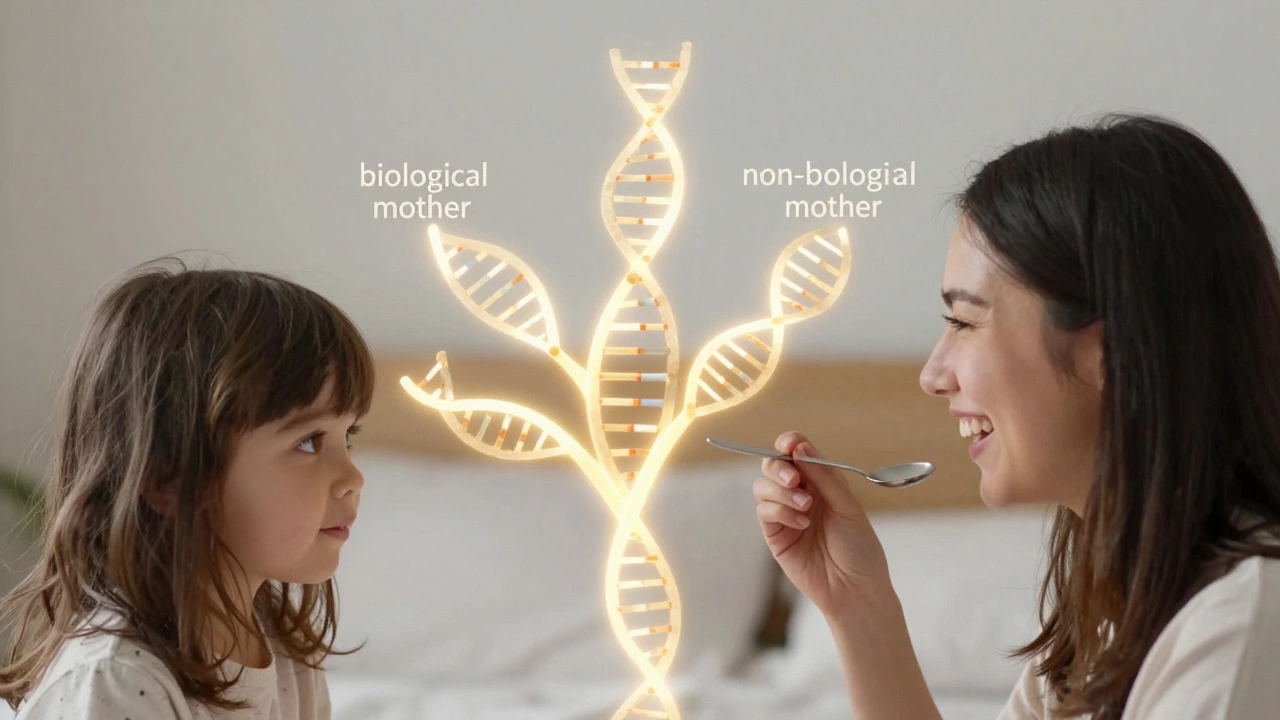
Many non-birth mothers report that over time, their child begins to resemble them-not in bone structure, but in expression. The way they laugh, the way they squint when thinking, the way they hold a spoon. These are learned traits, not inherited ones. A 2023 longitudinal study in the Journal of Family Psychology tracked 200 same-sex female couples with IVF children. By age five, 78% of children showed behavioral and expressive similarities to the non-biological mother, even though their physical features matched only the biological parent.
So while the baby won’t inherit her cheekbones or hairline, they’ll inherit her rhythm. And that matters just as much.

What If Donor Eggs or Sperm Are Used?
When donor eggs are used, the baby’s genes come from the donor and the sperm provider. The birth mother carries the baby but contributes no DNA. In this case, the child will look like the egg donor and the sperm provider-not the birth mother.
Same goes for donor sperm: if the egg comes from the intended mother, the child will look like her and the sperm donor-not the partner who carries the pregnancy.
Many clinics now offer detailed donor profiles, including photos from childhood, eye and hair color, height, and even personality traits. Some couples choose donors who resemble them physically to help with perceived resemblance. It’s a personal choice-and it’s common.
One couple in Minnesota used a donor whose photos showed strikingly similar cheekbones to the intended mother. When their daughter was born, strangers kept asking if she was adopted. "It was weird at first," the mom said. "Then we realized: we didn’t need her to look like us. We just needed her to be ours."
Can IVF Babies Look Like Both Parents If One Is Not Genetic?
No-not in the genetic sense.
You can’t force a child to inherit traits from someone who didn’t contribute DNA. But you can create a family environment where love shapes identity more than genes.
Think of it this way: if you adopt a child, they don’t look like you biologically. But you raise them, you teach them, you laugh with them-and over time, people say, "Oh, you two are so alike." That’s not genetics. That’s connection.
IVF families experience this too. A 2024 survey of 1,200 IVF families found that 89% of children were described by extended family and friends as "looking like their family," even when only one parent was genetically related. Why? Because families grow into each other. Shared routines, inside jokes, even the way you say "good morning"-those become part of how people recognize belonging.
Myth Busting: Common Misconceptions
- Myth: IVF babies look more like the doctor or clinic staff.
Truth: No scientific basis. This myth likely comes from old stigma around fertility treatments. - Myth: Using donor eggs means the baby won’t bond with the birth mother.
Truth: Bonding is emotional, not genetic. Hormones during pregnancy, skin-to-skin contact, and feeding all build attachment-regardless of DNA. - Myth: IVF babies are more likely to look "different" or "unusual."
Truth: IVF babies have the same range of appearance as naturally conceived children. No increased risk of physical anomalies from the IVF process itself.
What About the Sperm Donor? Do IVF Babies Look Like Him?
If the sperm donor is anonymous, the answer is: maybe.
Some clinics provide photos or detailed descriptions. If the donor has brown eyes and a dimpled chin, and the egg came from the mother, the baby might inherit those traits. But you can’t predict exact looks. Genetics is a lottery. One child might get the donor’s nose; another might get the mother’s smile. And that’s okay.
Some families choose open donors-people willing to be contacted later. Others prefer anonymity. Both choices are valid. What matters isn’t whether the child looks like the donor, but whether the family feels whole.
Real Stories, Real Resemblance
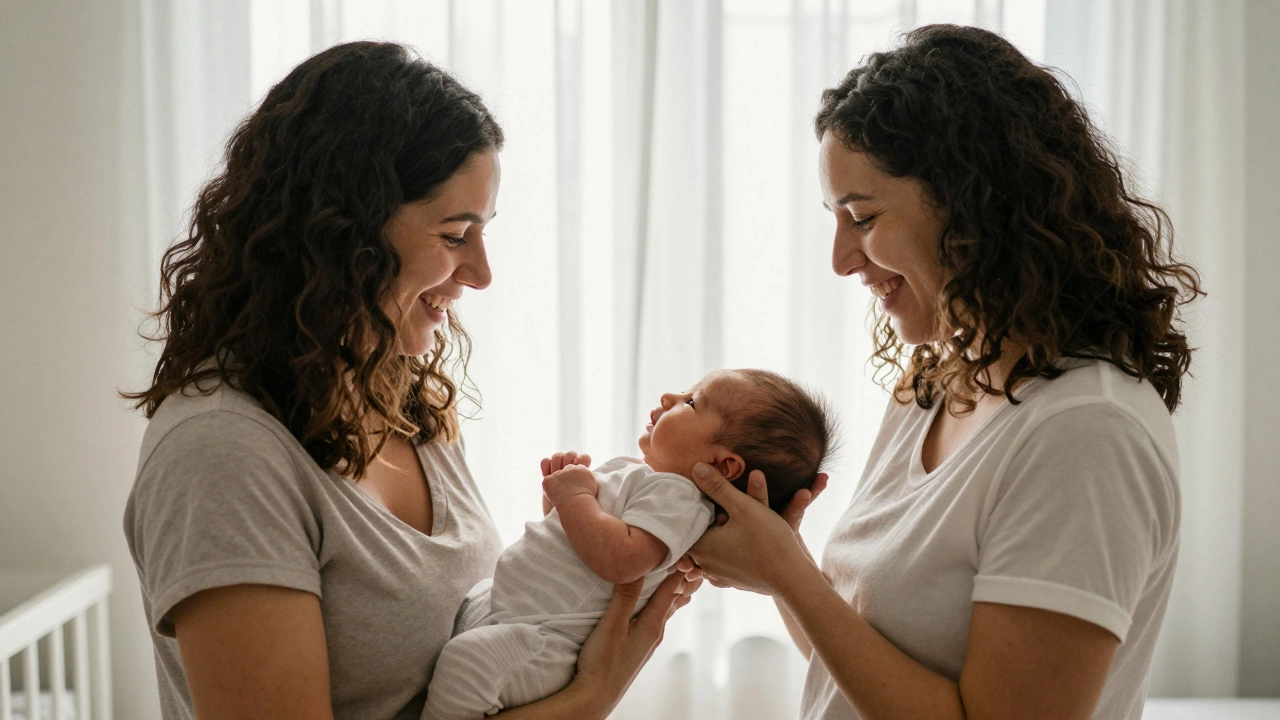
Jamila and Priya used IVF with Priya’s egg and donor sperm. Their daughter, Leila, has Priya’s dark curls and Jamila’s wide smile. People assume Jamila is the biological mom because Leila smiles just like her. "I didn’t give her DNA," Jamila says, "but I gave her bedtime stories, tears wiped away, and 3 a.m. hugs. She looks like me because I raised her."
Another couple, Elena and Sofia, used Elena’s egg and a donor with similar features to Sofia. When their son was born, Sofia cried. "He has the same forehead as me," she said. "I didn’t think that was possible." It wasn’t genetics. It was choice. They picked a donor who mirrored Sofia’s face-not to trick anyone, but to feel seen.
Final Thought: Looks Don’t Define Family
IVF babies don’t look like both moms if only one is genetically related. But they look like their family.
Family isn’t drawn in DNA. It’s drawn in daily moments: the way you kiss a scraped knee, the way you hum while making coffee, the way you say "I love you" when they’re asleep. Those are the traits that stick.
If you’re considering IVF and worried about resemblance-you’re not alone. But the truth is, the people who love your child won’t care if their nose matches yours. They’ll care that you love them. And that’s the only thing that truly makes a child look like home.
Do IVF babies look like their parents if they use donor eggs or sperm?
If a donor egg is used, the baby will look like the egg donor and the sperm provider-not the birth mother. If donor sperm is used, the baby will look like the egg provider and the sperm donor. Genetic resemblance only comes from the biological contributors. The birth mother, if she didn’t provide the egg, won’t pass on physical traits.
Can a non-biological mother in a same-sex couple have a child who looks like her?
Biologically, no-unless she provided the egg. But over time, children often develop expressions, mannerisms, and habits that mirror their primary caregivers. A child might not inherit the non-biological mother’s eye color, but they might laugh the same way, hold their spoon the same way, or say "no" with the same tone. Those are the kinds of resemblance that families notice-and cherish.
Is it common for IVF families to choose donors who resemble them?
Yes. Many fertility clinics offer detailed donor profiles including childhood photos, ethnicity, eye color, and even personality traits. Couples often select donors who share physical features with the non-genetic parent to help the child feel more connected to both parents. It’s not about deception-it’s about creating a sense of belonging.
Do IVF babies have higher chances of looking "different" or having birth defects?
No. IVF itself does not increase the risk of birth defects or unusual appearance compared to natural conception. The American Society for Reproductive Medicine states that IVF children have the same general health outcomes as naturally conceived children. Any differences in appearance are due to genetics, not the IVF process.
If I use my own egg, will my child look like my partner?
Only if your partner provided the sperm. If you used your own egg and your partner’s sperm, your child will inherit traits from both of you. If someone else provided the sperm, your child will resemble you and the sperm donor-not your partner. Physical resemblance is determined by biological contribution, not relationship status.