Portugal Medical Cost Estimator
Your Situation
Cost Estimate
Enter your details to see estimated costs
Compare Portuguese healthcare prices with US equivalentsImagine you are walking down a cobblestone street in Lisbon, the capital of Portugal, when suddenly your stomach twists with pain. You need a doctor, now. As an American, your first instinct might be panic about the cost or how to navigate a foreign system. But here is the good news: getting medical help in Portugal is straightforward, safe, and often significantly cheaper than back home.
The short answer is that if you go to the hospital in Portugal as an American, you will receive high-quality care. However, how much you pay-and whether you pay anything at all-depends entirely on one piece of paper: your health insurance. Without it, you are responsible for the full bill. With it, you might pay very little. Let’s break down exactly how this works so you aren’t caught off guard.
Understanding the Portuguese Healthcare System
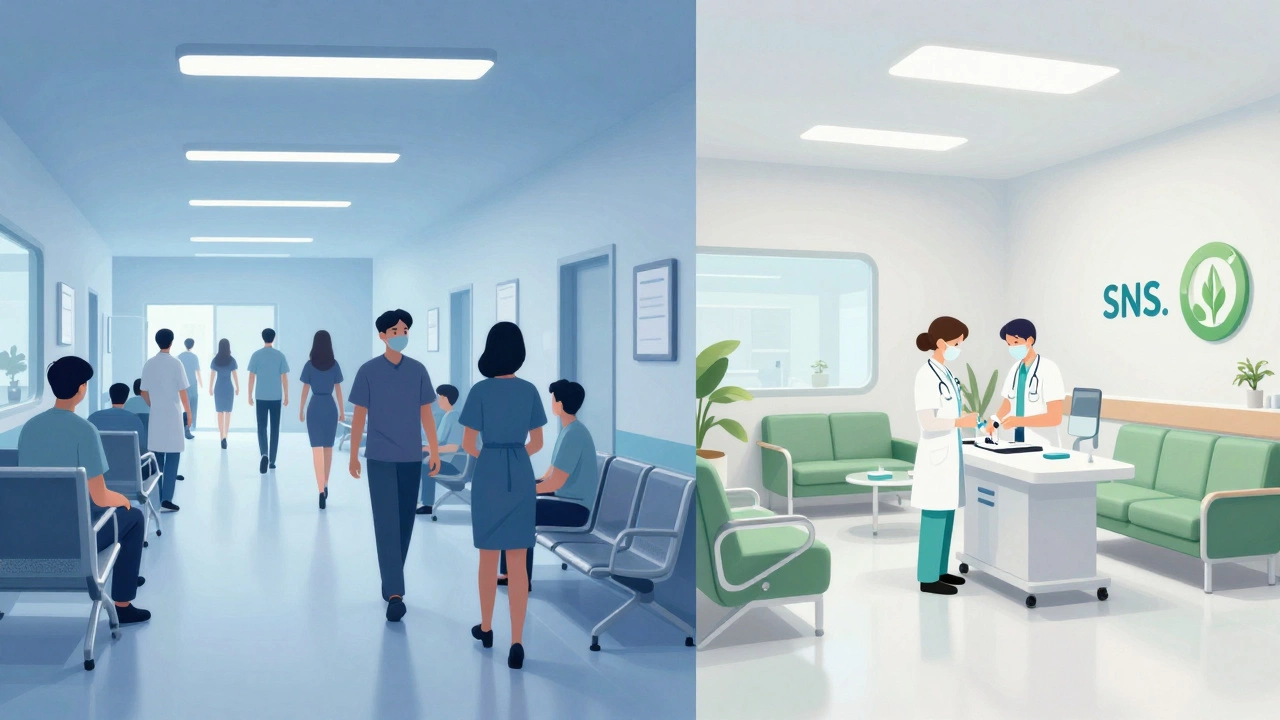
To know what happens when you walk into a clinic, you first need to understand the structure behind it. Portugal operates a hybrid model. At the core is the SNS (Serviço Nacional de Saúde), which is the public national health service funded by taxes. This system provides universal coverage to citizens and legal residents. It is free or low-cost at the point of service, but because it is underfunded compared to Western European standards, wait times can be long for non-emergency procedures.
Alongside the public system runs a robust private sector. Private hospitals and clinics are modern, efficient, and fast. They cater to locals who have private insurance and to foreigners. For an American tourist or expat, the private sector is usually where you will end up, either because you choose it for speed or because your insurance requires it.
| Feature | Public (SNS) | Private Sector |
|---|---|---|
| Cost | Free or nominal tax fee (Taxa Moderadora) | Full price unless covered by insurance |
| Wait Times | Long for specialists; immediate for emergencies | Short; appointments often within days |
| Quality | High standard, especially in emergencies | Excellent; many facilities are JCI accredited |
| Access for Americans | Emergency only (usually); requires residency for regular care | Open to everyone with payment/insurance |
The Critical Role of Health Insurance
This is the most important part of the equation. Your experience hinges on what kind of coverage you have before you arrive. There are three main scenarios for Americans:
- You have comprehensive international travel insurance. This is the gold standard. Policies from providers like Allianz Global Assistance or World Nomads typically cover emergency room visits, hospital stays, and sometimes even follow-up care. You pay upfront or get reimbursed later. This gives you access to the best private hospitals without financial ruin.
- You have a US domestic plan with no international coverage. Many standard US plans do not work outside the country. In this case, you are paying out-of-pocket. While still cheaper than US prices, a hospital stay can run thousands of euros. This is risky.
- You have no insurance. You will still be treated in an emergency. Portugal does not turn away people in critical condition. However, you will receive a bill for the full amount. For elective procedures, you must pay before or during treatment.
If you are moving to Portugal long-term, you cannot rely on US Medicare or Medicaid. They do not cover you abroad. Instead, you should look into local private insurers like Saúde Direct or Generali Portugal, or consider joining the SNS once you have legal residency status.
Scenario 1: The Emergency Room Visit
Let’s say you break your leg or have severe chest pain. Here is the step-by-step process of what happens:
Step 1: Call 112. This is the universal emergency number in Portugal (and all of Europe). Do not call 911. When you call 112, operators speak English in major cities like Lisbon and Porto. They will dispatch an ambulance. Ambulance services are generally free for emergencies, even for tourists, though policies can vary slightly by region.
Step 2: Arrival at the Hospital. You will likely be taken to the nearest public hospital emergency department (Urgências). Doctors there are trained to handle trauma and acute issues. You will be triaged based on severity, not ability to pay. Life-threatening conditions are treated immediately.
Step 3: Treatment and Billing. Once stabilized, if you need surgery or overnight care, the hospital administration will ask for identification. If you have travel insurance, provide your policy number. If you don’t, they may ask for a deposit or require payment upon discharge. Keep every receipt. Even small things like medication prescriptions need receipts for reimbursement.
Scenario 2: Non-Emergency Care
What if you just have a fever, a rash, or need a prescription refill? You probably don’t want to go to the ER. Here is what you do instead:
Visit a Centro de Saúde (Health Center). These are primary care clinics. While technically part of the public system, many accept self-paying patients. You might face a wait, but the consultation fee is low (around €5-€15) if you are uninsured. If you have insurance, check if they have a network of partner clinics. Using an in-network provider drastically reduces your costs.
Go Private. For faster service, book an appointment at a private clinic. Prices for a general practitioner visit range from €40 to €80. Specialists, such as cardiologists or dermatologists, charge between €60 and €120 per visit. This is a fraction of US costs, where a similar visit might cost $200-$500 without insurance.
How Much Does It Actually Cost?
One of the biggest draws of medical tourism in Portugal is the price difference. Let’s look at some concrete numbers to give you perspective. These are average estimates for self-paying patients in 2026:
- General Practitioner Consultation: €40 - €80
- Specialist Consultation: €60 - €120
- Emergency Room Visit (non-admission): €50 - €150
- Hospital Stay (private room): €300 - €600 per day
- Basic Lab Work (blood tests): €20 - €50 per test
- CT Scan or MRI: €150 - €300
Compare this to the United States, where an ER visit can easily exceed $1,000 and an MRI can cost over $1,500. Even without insurance, Portugal offers significant savings. However, "significant savings" doesn't mean "cheap" if you are facing a major surgery. That is why insurance remains essential.
Navigating Language Barriers
Will you be able to communicate with your doctor? In major urban centers like Lisbon, Porto, and Faro, yes. Most doctors and nurses in private hospitals speak fluent English. Medical professionals in Portugal often studied in English-speaking countries or are required to pass language proficiency tests for their licenses.
In smaller towns or rural areas, English proficiency drops. If you are traveling to the interior of Portugal, carry a translation app on your phone. Apps like Google Translate have offline modes that work well for medical terms. Also, write down your symptoms and medical history in English beforehand. Having a clear list helps bridge any communication gaps.
Prescriptions and Medications
If you need ongoing medication, such as for diabetes or hypertension, you can get prescriptions filled in Portugal. Pharmacies (Farmácia) are easy to spot-they have a bright green cross sign. Pharmacists in Portugal are highly educated and can advise you on minor ailments without needing a doctor’s visit.
Brand names differ. Your US brand of ibuprofen might be called something else here. Bring the generic name of your medication or a photo of the bottle. For controlled substances, bring a copy of your prescription from your US doctor. Customs officials may ask to see proof that the medication is for personal use.

Is Portugal Good for Medical Tourism?
Absolutely. Portugal has become a hotspot for medical tourism, particularly for dental work, cosmetic surgery, and fertility treatments. Why? Because the quality of care meets EU standards, the facilities are state-of-the-art, and the costs are lower than in the US or Northern Europe.
Many hospitals in Portugal, such as CUF Descobertas in Lisbon, hold accreditation from the Joint Commission International (JCI), the same body that accredits top US hospitals. This means you can trust the hygiene protocols, surgical safety, and patient care standards.
Practical Tips for Americans
To ensure your healthcare experience in Portugal goes smoothly, keep these tips in mind:
- Carry your insurance card digitally and physically. Save a PDF on your phone and take a photo. Have the emergency contact number for your insurer written down.
- Know your blood type and allergies. Wear a medical alert bracelet if you have severe allergies. Write this information in both English and Portuguese if possible.
- Keep all documentation. From initial diagnosis to final discharge papers, keep everything. You will need these for insurance claims and for your personal medical record.
- Use telemedicine. If you are unsure if you need to go to the hospital, try a telemedicine service. Many private groups offer video consultations with English-speaking doctors for a small fee. This can save you a trip to the ER for minor issues.
Conclusion: Peace of Mind Through Preparation
Going to the hospital in Portugal as an American is not a nightmare scenario. It is a manageable process, provided you are prepared. The system is designed to help people, and the quality of care is excellent. By securing proper travel insurance, knowing the emergency number (112), and understanding the difference between public and private options, you can focus on recovering rather than worrying about bills or bureaucracy. Whether you are a tourist enjoying the coast or an expat settling into a new life, Portugal’s healthcare system is ready to support you.
Does US Medicare work in Portugal?
No, US Medicare and Medicaid do not provide coverage outside of the United States. You will need to purchase separate international travel insurance or a private health plan that covers you in Portugal.
Can I join the Portuguese public health system (SNS) as a tourist?
Generally, no. The SNS is for legal residents and citizens. Tourists can access emergency care in public hospitals, but they are not entitled to free routine care. Long-term residents can apply for SNS coverage after obtaining legal residency status.
What is the emergency number in Portugal?
The universal emergency number in Portugal is 112. This connects you to police, fire, and medical emergency services. Operators in major cities often speak English.
Are doctors in Portugal able to speak English?
In private hospitals and clinics in major cities like Lisbon and Porto, most doctors speak fluent English. In rural areas or public health centers, English proficiency may be limited, so having a translation app is helpful.
How much does a private hospital stay cost in Portugal?
A private hospital room can cost between €300 and €600 per day, depending on the facility and location. Additional costs include doctor fees, tests, and medications. Travel insurance typically covers a large portion of these expenses.
Do I need to pay upfront for emergency care?
In a life-threatening emergency, treatment is provided first. However, for non-critical situations or private hospital admissions, you may be asked to provide proof of insurance or make a deposit before receiving care.