Orthopedic vs Orthopaedic Spelling Guide
Check Your Spelling
Enter a word related to bone/joint medicine to see which spelling is used in your region
Ever seen orthopedic spelled two different ways - one with an "o" and one with an "ae" - and wondered if they mean different things? You’re not alone. Walk into any hospital, clinic, or medical supply store, and you’ll see both versions. Some websites use "orthopedic." Others use "orthopaedic." Even doctors sometimes switch between them. So what’s the real difference? Is one wrong? Is one more professional? The answer is simpler than you think.
Same Word, Two Spellings
There is no medical or functional difference between "orthopedic" and "orthopaedic." They refer to exactly the same field of medicine: the branch that deals with bones, joints, ligaments, tendons, muscles, and nerves. Whether you’re seeing an orthopedic surgeon or an orthopaedic surgeon, you’re getting the same care. The same treatments. The same training. The same hospitals. The same outcomes.
The only thing that changes is spelling. And that’s purely about geography and language history.
Why Two Spellings Exist
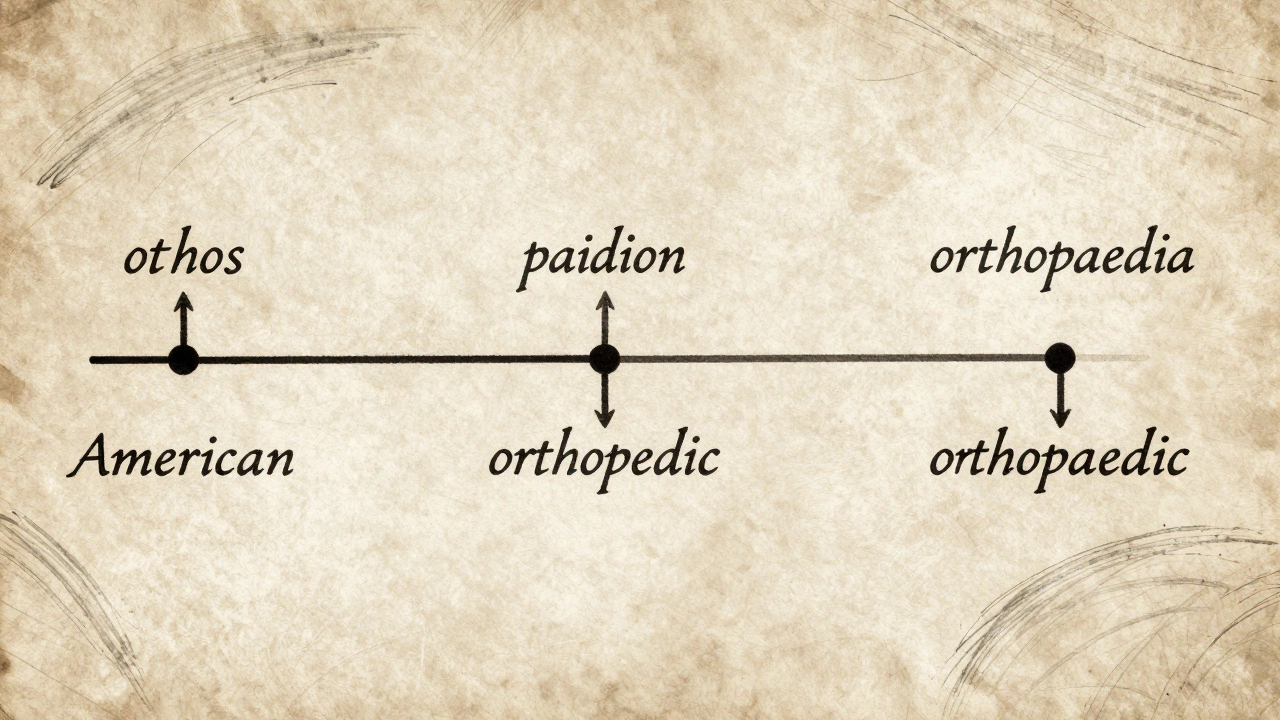
The word comes from the Greek "orthos," meaning straight, and "paidion," meaning child. Originally, it described treatments to correct spinal deformities in children. In the 18th century, French and British doctors started using the term "orthopaedia." Over time, British English kept the "ae" ligature - "orthopaedic" - as a nod to its classical roots.
Meanwhile, American English simplified spellings in the late 1800s. The "ae" became just "e." So "orthopaedic" turned into "orthopedic." This was part of a bigger trend - "color" instead of "colour," "center" instead of "centre." The change wasn’t about accuracy. It was about efficiency.
Which One Should You Use?
If you’re in the United States, Canada, or the Philippines - use "orthopedic." That’s the standard. You’ll see it on hospital signs, insurance forms, job postings, and medical textbooks.
If you’re in the United Kingdom, Australia, New Zealand, South Africa, or India - you’ll most often see "orthopaedic." That’s the official spelling in those countries. Even medical journals there use "orthopaedic."
Here’s a quick guide:
- United States, Canada, Philippines: orthopedic
- United Kingdom, Australia, New Zealand, South Africa, India: orthopaedic
Both are correct. Neither is outdated. Neither is less professional.
What About Hospitals and Surgeons?
Some hospitals in the U.S. still use "orthopaedic" - often because they were founded by British-trained doctors or have historical ties to Europe. But they’re the exception. Most U.S. clinics, medical schools, and insurance providers stick with "orthopedic."
In the UK, you’ll rarely see "orthopedic." Even when American companies like Johnson & Johnson or Stryker market their products there, they use "orthopaedic" to match local standards.
Surgeons don’t choose one spelling over another based on skill. A surgeon who calls themselves "orthopedic" in Chicago has the same training as one who calls themselves "orthopaedic" in London. Both passed the same board exams. Both completed the same residency. Both can perform knee replacements, spinal fusions, or fracture repairs.
Does It Affect Your Care?
No. Not at all.
If you’re searching for a specialist, don’t get hung up on the spelling. Type both versions into Google. You’ll find the same doctors, the same clinics, the same services. If you’re filling out a form and it asks for "orthopaedic" but you wrote "orthopedic," it won’t be rejected. Insurance companies accept both. Hospitals don’t care which one you use.
Even medical records systems like Epic or Cerner recognize both spellings. They’re programmed to treat them as synonyms. Your diagnosis, treatment plan, and billing won’t change based on spelling.
What About the Word "Orthopaedics"?
You might also see "orthopaedics" (with an "s") used as a plural noun. For example: "She studies orthopaedics." Or: "The department of orthopaedics is on the third floor."
In American English, you’ll hear "orthopedics" more often. But again - it’s the same thing. "Orthopedics" and "orthopaedics" both refer to the medical specialty as a whole.
Think of it like "theater" vs. "theatre." One spelling is American. The other is British. The art form doesn’t change.

Common Confusions
Some people think "orthopaedic" is more scientific because it looks older. It’s not. The "ae" spelling isn’t more accurate. It’s just older.
Others assume "orthopedic" is slang or informal. It’s not. It’s the official spelling in the U.S. and is used in all medical textbooks published there.
And no - "orthopaedic" isn’t a typo. It’s not a mistake. It’s a legitimate variant. Using it in the U.S. won’t make you look unprofessional. It just might raise an eyebrow.
Real-World Examples
Take the American Academy of Orthopaedic Surgeons. Their official name uses "Orthopaedic." But their website is orthopedics.org. Why? Because they use the American spelling for their public-facing content.
The British Orthopaedic Association? Their website is orthopaedics.org.uk. They use the British spelling.
Even the World Health Organization uses both. In their global reports, they list "orthopaedic" as the primary term but note "orthopedic" as an alternative.
Bottom line: The world uses both. The medical field accepts both. You should too.
What Should You Do?
Use the spelling that matches your region. If you’re in the U.S., write "orthopedic." If you’re in the UK, write "orthopaedic."
If you’re writing for a global audience - pick one and stick with it. Don’t mix them. Consistency matters more than which version you choose.
And if you’re a patient? Don’t overthink it. If your doctor says "orthopedic" and your friend says "orthopaedic," they’re talking about the same thing. Your hip replacement, your ACL repair, your scoliosis treatment - none of it changes based on spelling.
It’s like saying "color" vs. "colour." One isn’t better. One isn’t right. They’re just different ways of saying the same word.